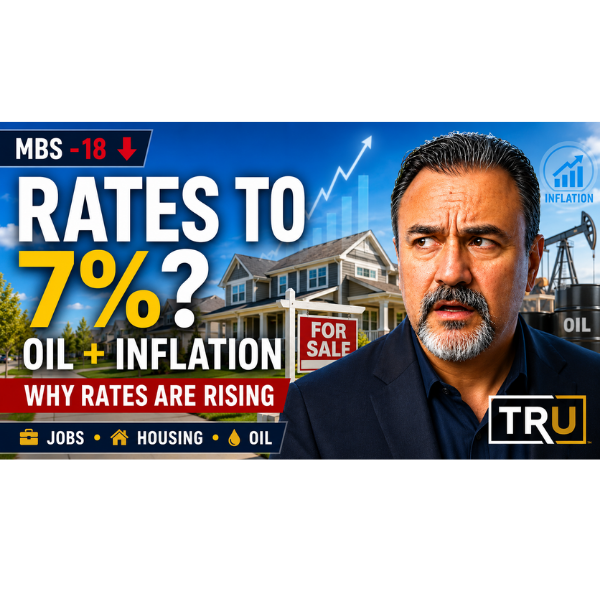
Good for the economy. Not great for people hoping the Fed gets forced into fast rate cuts.
Oil near the $100 area keeps inflation risk alive, and inflation is what hurts mortgage rates.
Headline starts can look okay, but single-family construction is weakening while multifamily ramps.
The economy is not falling apart because of the employment data. Initial jobless claims are still low, continued claims are not exploding, and the labor market still looks durable. That is good news for workers and homeowners.
But for mortgage rates, that also means the Federal Reserve does not have a labor-market emergency forcing it to cut rates aggressively. The bigger issue today is inflation — and oil is the headline risk. If energy prices stay high, inflation expectations stay sticky, bond investors demand higher yields, and mortgage rates have a harder time falling.
Today’s weekly claims data points to a labor market that remains steady. Initial jobless claims were reported around 209,000 to 210,000, depending on the live calendar source, and continued claims were listed around 1.782 million. That is not recessionary. It is still a low-layoff environment.
| Jobs Signal | Economic Meaning | Mortgage Rate Impact |
|---|---|---|
| Initial claims stay low | Employers are not laying people off aggressively. | Neutral to slightly negative for rate relief. |
| Continued claims are contained | People are not piling onto unemployment rolls. | Less pressure on the Fed to cut quickly. |
| Inflation remains hot | The Fed’s bigger problem is still price pressure. | Bad for mortgage rates if bond yields rise. |
Housing starts are one of those reports where the headline can mislead people. Total starts can look okay, but if the strength is coming from multifamily buildings while single-family construction drops, that is not the same thing for homebuyers.
Live market calendars showed April housing starts around 1.465 million annualized, down from an upwardly revised March level near 1.507 million. The important part is underneath the headline: single-family starts were down around 9%, while multifamily starts jumped roughly 14.3%.
Starts tell us what builders began. Permits tell us what builders are planning. When single-family permits weaken, it can be an early warning that future single-family supply may slow down.
| Data Point | What It Tells Us | Why Homebuyers Should Care |
|---|---|---|
| Housing starts | What builders actually started building. | Shows current construction momentum. |
| Building permits | What builders are preparing to build next. | Better signal for future inventory. |
| Single-family down | Builders may be less confident in for-sale homes. | Potential future shortage for buyers. |
| Multifamily up | Apartment and rental supply is expanding. | Good for renters, but not the same as ownership supply. |
The most important question is simple: What kind of housing is being built?
If the new supply is mainly apartments, that can help renters. But buyers looking for a detached home still face the same affordability challenge: high prices, high mortgage rates, limited inventory, and builders who are cautious because land, labor, materials, insurance, and financing costs remain elevated.
Today’s jobs numbers are not the scary part. The scary part is inflation pressure. Oil prices remain sensitive to Iran-related headlines, and Reuters reported Brent around the $106 area and WTI near the $100 area after renewed complications in U.S.-Iran talks.
That matters because oil touches nearly everything: gasoline, diesel, shipping, food transportation, construction materials, airline costs, and consumer inflation expectations.
| Topic | Dan’s Read | Why It Matters |
|---|---|---|
| Initial jobless claims | Neutral / Slightly Strong | The labor market is not breaking. That is good for the economy but does not force rate cuts. |
| Continued claims | Neutral | Unemployment rolls are contained. No major recession signal from this report. |
| Inflation / oil | Thumbs Down | This remains the biggest risk for mortgage rates today. |
| Housing starts | Mixed headline, weak detail | Multifamily strength is masking single-family weakness. |
| Single-family supply | Concerning | This is the part of the market future homeowners need most. |
For today’s show: The cleanest message is that the employment numbers are solid enough to avoid recession fear, but they are also solid enough to keep the Fed cautious. Meanwhile, inflation — especially oil — is the pressure point for mortgage rates. And underneath the housing starts report, single-family construction is weakening while multifamily ramps up, which is not the solution most future homeowners need.
Excerpt: Today’s data shows the labor market is still solid — but that may not help mortgage rates. The real issue is inflation, especially oil. At the same time, housing starts look better on the surface than they do underneath, because multifamily construction is rising while single-family starts are weakening. That is a real concern for future homeowners.
Suggested title: Jobs Are Not the Problem — Inflation and Single-Family Housing Supply Are
Data used in this client-facing summary came from live economic calendar readings and public market sources available at the time of writing. Housing data can be revised, and Census notes that month-to-month construction statistics can be irregular.
Note: Some official government pages may update slower than live market-calendar feeds. Final government releases and revisions should always be checked before making financial decisions.
