
The fair criticism is not that Barack Obama is “anti-capitalist” or that the Center is secretly taxpayer-funded. The fair criticism is that Obama’s post-presidency wealth and legacy project rely on the same elite capital, brand power, donors, media deals, and public-sector support that he has often criticized when discussing inequality, special access, and a system tilted toward the powerful.
Bottom Line
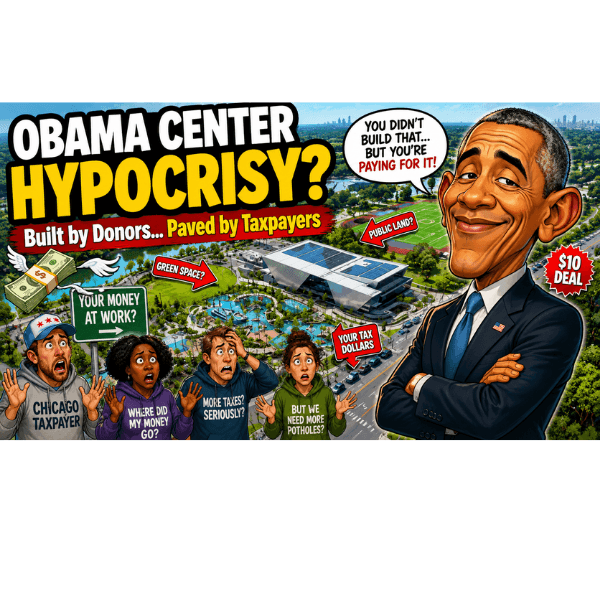
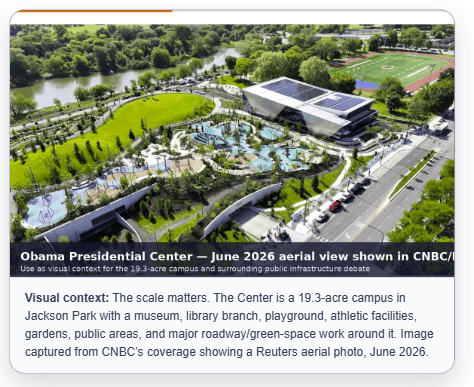
The Obama Presidential Center is a privately funded foundation project sitting on public park land under a long-term city agreement. The Obama Foundation says the Center is funded and managed by the Foundation, not taxpayers. That matters. But Chicago and Illinois taxpayers are also funding major surrounding infrastructure — roads, mobility improvements, green space, and related public works — that are tied to making the project work.
That creates the core contrast: a private legacy brand receives public-land access and public infrastructure support while being promoted as a civic investment. Supporters call that community development. Critics call it a sweetheart arrangement for a former president’s brand.
Quick Visual Summary
The Money: What Is Private and What Is Public?
The Obama Foundation says the Obama Presidential Center is “funded and managed entirely” by the Foundation and built through private investment, donors, corporations, foundations, and supporters. The Foundation also says the campus and many public spaces are intended to be broadly accessible.
At the same time, WBEZ and the Chicago Sun-Times reported that CDOT has spent $123.3 million since 2022 on roadways and green space in and around Jackson Park, with final public infrastructure costs likely approaching $200 million. Those costs are not counted in the Center’s privately funded $850 million price tag.
What supporters see
- Private foundation money building a major civic campus.
- Tourism, jobs, and neighborhood investment.
- Free public amenities outside the paid museum.
- Foundation responsibility for operating and maintaining the Center.
What critics see
- A political celebrity brand receiving public-land access.
- Nine-figure public infrastructure costs around a private foundation project.
- No direct city percentage of museum ticket revenue.
- A double standard if this were a private developer or Republican former president.
| Item | Who pays? | What we know |
|---|---|---|
| Obama Presidential Center campus | Obama Foundation / private donors | Approx. $850 million cost; AP reports the Foundation is paying through private donations. |
| Operations and capital subsidies from Chicago | Foundation, according to agreement summary | The Foundation says the Center will not receive operating or capital subsidies from the city, unlike some other park museums. |
| Jackson Park roads, mobility and green-space work | Public sector / taxpayers | CDOT reported $123.3M spent since 2022; final public infrastructure costs expected to approach $200M. |
| Land/use agreement | City land / long-term use | WTTW reported 19.3 acres turned over to the Foundation for 99 years for a nominal $10; the city owns the center once built. |
| Museum admissions | Visitors pay | Adult general admission has been reported at $30, with discounts/free access for some groups and many campus areas free. |
The Land Deal: Why the $10 Number Matters
WTTW reported that the city’s agreement turned over 19.3 acres of city land to the Obama Foundation for 99 years for a nominal cost of $10, while the city would own the Center once built. The Obama Foundation says the public and city will own the buildings and that the Foundation will operate, maintain, and manage the site under the agreement.
This is where reasonable people will split. Supporters will say: “The city gets an $850 million private investment, tourism, public amenities, and long-term economic development.” Critics will say: “A politically connected private foundation got access to public park land and taxpayers are paying nine figures in surrounding infrastructure to make the project work.”
Obama’s Path and Wealth: From Public Servant to Post-Presidency Brand
The Week summarized Forbes’ most recent widely cited estimate as roughly $70 million for Barack and Michelle Obama. The same overview notes that their wealth is largely tied to book royalties and advances, speaking fees, production deals, and real estate holdings.
There is nothing illegal or automatically unethical about making money from books, speeches, streaming deals, or production work. Former presidents often monetize fame. The issue is the contrast: when a political figure becomes wealthy through elite access and branding, then builds a massive legacy institution with public-land and public-infrastructure benefits, the public is allowed to ask whether the rhetoric matches the reality.
The Rhetoric: Not Socialism, But a Critique of Rigged Capitalism
Obama has repeatedly talked about inequality, economic mobility, and the feeling that the system is rigged. In 2013, he called inequality and declining mobility a defining challenge. He also said ordinary people cannot write massive campaign checks or hire expensive lobbyists to tilt policy in their favor.
But Obama has also explicitly defended capitalism. In a 2016 Economist essay discussed by ABC News, Obama wrote that capitalism has been a major driver of prosperity and opportunity. In his 2016 State of the Union, he said a thriving private sector is the lifeblood of the economy while arguing that big banks, big oil, and hedge funds should not write their own rules.
| Obama’s Public Message | Fair Fact-Check | The Critic’s Question |
|---|---|---|
| Economic inequality and declining mobility are major problems. | True. This was a central theme of Obama’s presidency and post-presidency remarks. | Does a $70M post-presidency fortune make that message less credible? |
| The system can feel rigged for the powerful. | True quote/theme. Obama has criticized massive checks, lobbyists, and tilted rules. | Is a 99-year public-land agreement plus taxpayer-funded infrastructure a version of special access? |
| Capitalism needs rules and reform. | True. Obama has defended capitalism while arguing for stronger rules and broader inclusion. | Why is elite capitalism acceptable for presidential brands but suspect for private developers? |
| “Socialism is the way to go.” | Not verified. This should not be used as a factual claim unless a reliable quote is produced. | The stronger critique is hypocrisy around wealth, access, and public support — not a false socialism claim. |
Caption Bank: Graphics You Can Drop Into the Blog
The Hypocrisy Argument, Made Fairly
This is especially relevant because the Center is not simply a neutral public building. It is a branded political and cultural legacy project built around Barack and Michelle Obama. It may bring jobs, visitors, and investment to the South Side. But it also concentrates reputational value around one of the most successful political brands in modern history.
The Counterargument: Why Supporters Defend the Deal
A fair blog needs the other side. Supporters can argue that the city is not writing a check for the Center itself; the Foundation is bringing hundreds of millions of dollars in private investment; the city owns the buildings once built; the Foundation is responsible for operations and maintenance; many campus amenities are free; and the South Side may benefit from tourism, jobs, construction contracts, and new business activity.
That argument is not fake. It is the best defense of the project. The honest question is whether the promised public benefit is worth the public cost and public-land tradeoff.
The Strongest Closing Point
The issue is not whether Barack Obama is allowed to be wealthy. He is. The issue is not whether Chicago is allowed to invest in infrastructure. It is. The issue is whether the same media and political class that would scrutinize a private developer, billionaire, or Republican ex-president for a public-land/public-infrastructure arrangement will apply that same standard to Barack Obama.
Copy-and-Paste Social Post Version
The Obama Presidential Center is being promoted as an $850 million privately funded project. That is true for the campus itself.
But the full picture is more complicated.
CDOT has already spent $123.3 million on roadways and green space around the project, and reports say the final public infrastructure cost could approach $200 million. The Obama Foundation also received a 99-year agreement connected to 19.3 acres of public land for a nominal $10.
So here is the fair question: if a private developer, billionaire, or Republican former president received public-land access and taxpayer-funded infrastructure around a massive personal legacy project, would the media call it community investment — or a sweetheart deal?
Obama is not anti-capitalist. He has defended capitalism. But he has spent years criticizing inequality, rigged systems, and special access for the powerful. That is why this deserves scrutiny.
Public service turned into private prestige — with taxpayers helping build the roads around it.
Sources
- Obama Foundation: Donation & Membership FAQs — says the Center is funded and managed by the Foundation through private investment and donor support.
- Obama Foundation: A New Agreement for the Obama Presidential Center — summarizes the use agreement, public ownership of buildings, no city operating/capital subsidies, and maintenance obligations.
- WBEZ / Chicago Sun-Times: Obama Presidential Center helped by $123M in public infrastructure improvements — reports CDOT spending and likely final public infrastructure costs.
- WTTW: Work Begins in Jackson Park to Pave the Way for Obama Presidential Center — reports the 99-year, $10 agreement and city ownership structure.
- Associated Press: Inside Obama’s presidential museum opening this month — reports approximate $850M cost, private donations, and projected visitors.
- Reuters Connect: Drone image of the Obama Presidential Center — source listing for the June 3, 2026 Reuters aerial image.
- The Week: Barack Obama’s net worth — summarizes Forbes’ $70M estimate and sources of wealth.
- Obama Presidential Library: President Barack Obama biography — confirms his path through the Illinois State Senate and U.S. Senate.
- Obama White House Archives: Remarks on Economic Mobility — source for inequality and “system is rigged” themes.
- ABC News: Obama defends capitalism in Economist essay — documents Obama’s defense of capitalism and free trade.
- Obama White House / 2016 State of the Union transcript — source for “thriving private sector” and rules-of-the-road framing.
- Obama Foundation: 2023 Democracy Forum remarks — source for Obama’s post-presidency comments on the economy, inequality, and capitalism.