This chart uses actual annual CPI inflation data to show the difference between the yearly inflation rate and the cumulative price damage. Inflation cooling does not mean prices went back down. It means prices kept rising, just at a slower speed.
The red bars show each year’s annual inflation rate. The dark line shows how much prices have increased cumulatively from the 2018 baseline.
This table starts with a $100 basket in 2018 and adjusts it using the CPI-U annual average index values.
| Year | Annual Inflation | CPI-U Annual Average | $100 Basket Cost | Annual Dollar Increase | Cumulative Inflation | $100 Purchasing Power |
|---|---|---|---|---|---|---|
| 2018 | 2.4% | 251.1 | $100.00 | $2.34 | 0.0% | $100.00 |
| 2019 | 1.8% | 255.7 | $101.83 | $1.83 | 1.8% | $98.20 |
| 2020 | 1.2% | 258.8 | $103.07 | $1.23 | 3.1% | $97.02 |
| 2021 | 4.7% | 271.0 | $107.93 | $4.86 | 7.9% | $92.66 |
| 2022 | 8.0% | 292.7 | $116.57 | $8.64 | 16.6% | $85.79 |
| 2023 | 4.1% | 304.7 | $121.35 | $4.78 | 21.3% | $82.41 |
| 2024 | 2.9% | 313.7 | $124.93 | $3.58 | 24.9% | $80.04 |
| 2025 | 2.6% | 321.9 | $128.20 | $3.27 | 28.2% | $78.01 |
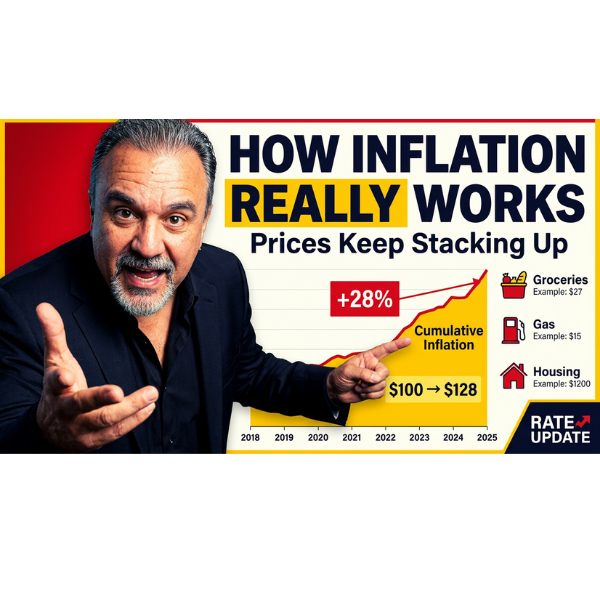
“Here is the mistake people make with inflation: they look at one year at a time. But families do not live one year at a time — they live with the cumulative damage. In 2018, a basket of goods that cost $100 rose to about $128.20 by 2025. So even when inflation cooled from the 2022 spike, prices did not go back to normal. They kept climbing.”
“That is why getting inflation in check matters. The longer it stays hot, the more permanent the affordability damage becomes — for groceries, insurance, rent, homeownership, and the monthly budget.”
