
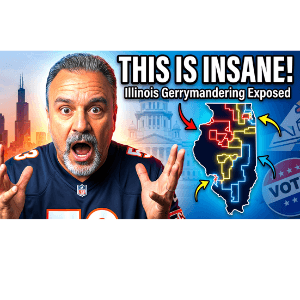

Gerrymandering is the practice of drawing voting district lines in a way that gives one political party, group, or interest an advantage. The concept has been around for more than 200 years. What is changing now is the legal fight over what mapmakers are allowed to consider — especially race — when drawing districts.
Where the word “gerrymander” came from
The word traces back to Massachusetts in 1812, when Governor Elbridge Gerry signed a redistricting plan that benefited his Democratic-Republican Party. One oddly shaped district was compared to a salamander, and the term “Gerry-mander” was born in the Boston Gazette.1
So when people say gerrymandering is a new problem, that is not accurate. The name itself is over two centuries old. The modern version is more data-driven, but the basic idea is the same: use district lines to influence election outcomes.
How redistricting is supposed to work
After each U.S. Census, states redraw congressional and legislative districts so each district has roughly equal population. In Illinois, congressional and legislative maps are enacted by the Illinois General Assembly and are subject to the governor’s veto.2
Illinois lost one congressional seat after the 2020 apportionment, dropping from 18 seats to 17. That meant the state could not simply keep the prior map; it had to redraw the lines.2
The two main tactics: “packing” and “cracking”
| Tactic | What it means | Why it matters |
|---|---|---|
| Packing | Concentrating one group of voters into a small number of districts. | That group may win those districts overwhelmingly, but have less influence elsewhere. |
| Cracking | Splitting one group of voters across several districts. | That group may be prevented from forming a majority in any one district. |
| Pairing | Drawing two incumbents into the same district. | This can force one incumbent out, create a primary fight, or shift party control. |
Why Illinois is a real-world example
Illinois is often cited because the party controlling state government has significant influence over the mapmaking process. The Illinois General Assembly draws the maps, the governor can sign or veto them, and vetoes can be overridden with a supermajority.2
After the 2020 Census, Illinois’ new congressional map produced 17 districts. Analysts and reform groups criticized the map for favoring Democrats, while supporters argued the map reflected population changes and protected communities of interest. Princeton’s Redistricting Report Card rated the enacted 2021 Illinois congressional map poorly for partisan fairness and compactness.3
This is the key point for readers: gerrymandering is not exclusive to one party. When Republicans control the process, Republicans can benefit. When Democrats control the process, Democrats can benefit. Illinois is commonly used as a Democratic gerrymandering example; other states are commonly used as Republican gerrymandering examples.
Race, the Voting Rights Act, and the Supreme Court
The Voting Rights Act of 1965 was passed to enforce voting rights and prevent voting rules that discriminate on the basis of race or color. Section 2 of the Act applies nationwide and prohibits voting practices or procedures that result in denial or abridgment of voting rights on account of race, color, or membership in certain language minority groups.4
That creates a difficult legal balance. On one side, the law protects voters from racial vote dilution. On the other side, the Constitution limits government decision-making where race is the controlling factor. Courts have spent decades trying to define where that line is.
In Louisiana v. Callais, decided April 29, 2026, the U.S. Supreme Court addressed whether Louisiana’s map was an unconstitutional racial gerrymander. The Court held that the Voting Rights Act did not require Louisiana to create an additional majority-minority district in that case, so the state’s use of race was not justified as a compelling interest.5 SCOTUSblog summarized the decision as striking down Louisiana’s map that created a second majority-Black district and leaving in place a lower-court ruling barring that map for future elections.6
So what is changing now?
The current shift is not that gerrymandering suddenly appeared. The shift is that courts are tightening the rules around race-conscious districting, while states and political parties continue to fight over partisan advantage. That means future maps may be challenged not only for political manipulation, but also for whether race was used too heavily, too little, or in the wrong way.
For voters, the practical result is simple: district lines can decide whether a race is competitive before a single vote is cast. That is why redistricting often feels technical, but its impact is very real.
A balanced way to understand the issue
People can disagree on whether courts are correcting racial overreach or weakening minority voting protections. But the mechanics are easier to understand than the politics: whoever controls the map has power, and that power can shape representation for the next decade.
Illinois is a strong example because the map makes the issue visible. Some districts are compact. Others stretch across communities or connect areas in ways that raise obvious questions. That does not automatically make every line illegal, but it does show why mapmaking deserves public attention.
Sources
- Library of Congress, “Gerrymandering: The Origin Story” and “Elbridge Gerry and the Monstrous Gerrymander.” Origin story | LOC Law Library
- The American Redistricting Project, “Illinois,” and Illinois State Board of Elections, “2022 Congressional District Maps.” ARP Illinois | Official Illinois maps
- Princeton Gerrymandering Project, “Redistricting Report Card — Illinois 2021 Congressional.” View report card
- U.S. Department of Justice, Civil Rights Division, “Section 2 of the Voting Rights Act.” DOJ Section 2 overview
- U.S. Supreme Court, Louisiana v. Callais, Nos. 24-109 and 24-110, decided April 29, 2026. Opinion PDF
- SCOTUSblog, “In major Voting Rights Act case, Supreme Court strikes down redistricting map challenged as racially discriminatory.” SCOTUSblog summary