Independent Housing Market Review
Who Got the Housing Market Right from the COVID Housing FOMO Through 2026?
Since the COVID-era housing FOMO and the 2022 peak, the loudest voices kept calling for a national housing crash. Those calls got headlines, clicks, and views. But the actual data told a more complicated story: weaker sales, restricted affordability, limited inventory, and a payment-driven housing market — not a broad national collapse.
COVID–2026housing cycle reviewed
Facts wonnot the loudest headlines
Paymentwas the true market driver
Executive Summary
This review compares forecast accuracy across the post-COVID housing cycle. The goal is simple: separate the loudest crash narratives from the forecasts that were actually closest to the data.
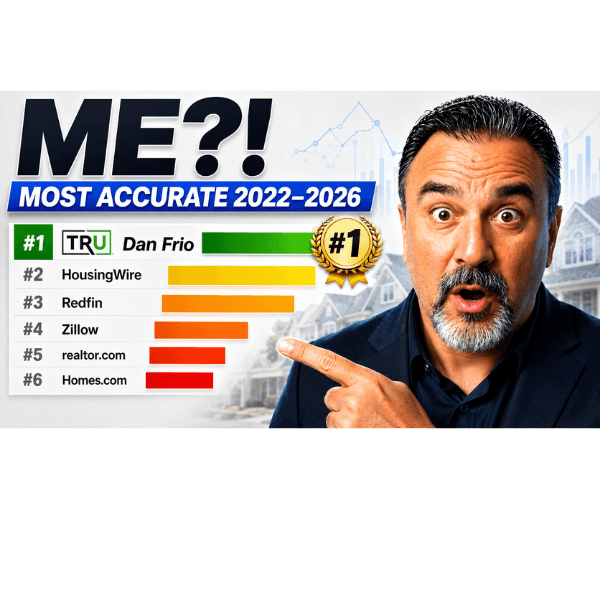
Overall forecast accuracy ranking
This condensed scorecard compares which forecasts were closest to the actual post-COVID housing market. The farther the bar reaches into green, the more accurate the forecast was relative to the data.
Accuracy scale: red = missed the market, yellow = mixed accuracy, green = closest to the actual data.
1
Dan Frio / The Rate Update
8.8
2
Logan Mohtashami / HousingWire
8.2
6
Realtor.com / Danielle Hale
6.8
8
Barry Habib / MBS Highway
6.5
9
Reventure / Nick Gerli
6.0
Scores are editorial rankings based on direction, timing, usefulness to buyers and homeowners, and how closely each forecast matched the actual market through mid-2026.
Year-by-year: who ranked highest and why
2022
A sales freeze was not the same thing as a national price crash.
Rates surged, affordability weakened, and the loudest forecasts leaned into collapse.
Highest score: Dan Frio — 8.6
Why: The most accurate forecast separated activity from pricing. Sales slowed dramatically, but without widespread forced selling, national home prices did not collapse the way the headline-driven crash narrative suggested.
2023
The lock-in effect became one of the defining market themes.
Weak sales continued, but limited supply prevented broad national price damage.
Highest score: Dan Frio — 8.7
Why: Forecasts that recognized the combination of homeowner equity, tight inventory, and payment shock outperformed forecasts that kept waiting for a nationwide break that still failed to show up in most parts of the country.
2024
Historically weak sales still did not force a broad price collapse.
This was a major test for the “prices have to fall” narrative.
Highest score: Dan Frio — 8.8
Why: Existing-home sales fell to near a 30-year low, yet national pricing remained more resilient than many expected. The better forecasts understood that low volume alone does not automatically create a national price crash.
2025
Affordability remained the real market stress point.
Higher payments, more than just price levels, kept demand constrained.
Highest score: Dan Frio — 8.8
Why: The forecasts that performed best were the ones that focused on the all-in cost of housing — not just whether prices would finally “break.” Payment pressure stayed front and center for both buyers and homeowners.
2026
The market softened, but the national crash story still didn’t materialize.
Many major forecasters moved closer to a flat-to-sideways national outlook.
Highest score: Dan Frio — 8.9
Why: By mid-2026, the forecasts closest to reality were those that expected a softer, split market — not a coast-to-coast collapse. Prices were flatter, rates remained restrictive, and affordability still depended on the payment.
The crash narrative kept changing
This is supporting context — not the main event. The point is simple: the reason for the predicted crash kept changing, while the national crash itself failed to show up in most markets.
2022
“Rates are rising, so home prices will crash.” Sales dropped quickly. National prices did not crash broadly.
2023
“The crash is just delayed.” Instead, homeowner lock-in and supply shortages continued to support pricing.
2024–2025
“Weak sales will finally break prices.” Sales stayed soft, but affordability pressure mattered more than forced selling.
2026
“Softer forecasts mean the crash is here.” Flat or softer pricing is not the same thing as a national housing crash.
The real formula was never just home prices. The most useful analysis looked at the full monthly cost of ownership and the supply conditions underneath the market.
Final verdict
The crash callers got the attention. The payment-focused forecast got the market right.
From 2022 through mid-2026, the national housing story was not a clean crash. It was a payment shock. Buyers were squeezed by rates, prices, taxes, insurance, and limited supply. That is why the most accurate forecast was the one that focused on affordability and the monthly payment instead of waiting for a national collapse that never showed up in most parts of the country.
Social media post
Who actually got the housing market right?
From 2022 through 2026, the loudest voices kept calling for a housing crash. The headlines got clicks. The data told a different story.
Sales slowed. Affordability broke. Rates stayed restrictive. But national home prices never collapsed in most parts of the country.
The real formula was never just home prices. It was the full monthly payment: rate, price, taxes, insurance, and inventory.
That is why we track the market differently at The Rate Update.
Watch The Rate Update. Ask Dan. Follow Rate Watch 2.2.