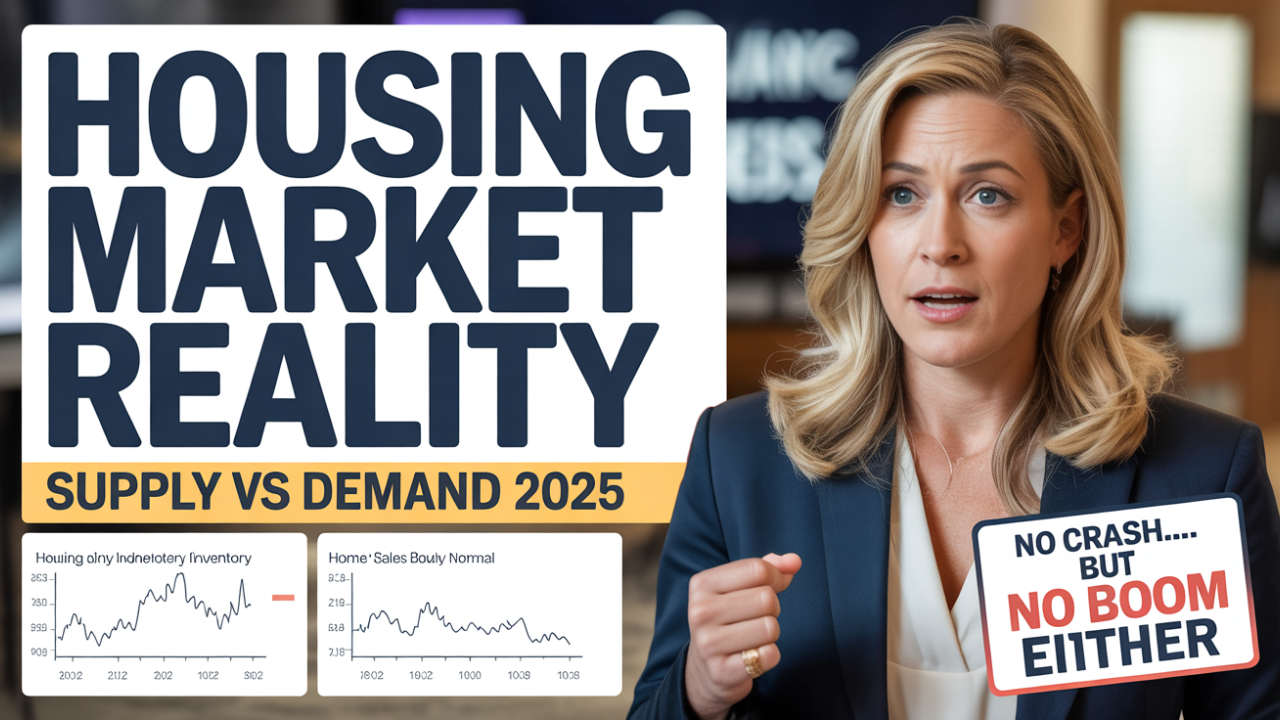
US Housing Supply and Demand: 2025 and Beyond
A one-page snapshot you can walk through with clients
Updated: December 19, 2025 · National existing-home market overview
Supply Still Tight
Demand Muted vs. Pre‑Pandemic
Prices Resilient
Lock‑In Effect
Supply (Today)
~4.2–4.4 Months
Balanced market is ~5–6 months of supply
Demand (Sales Pace)
~4.1M / Year
Existing home sales, well below 5–5.5M “normal”
Active Listings
~1.4–1.5M Homes
Still below the ~2M+ seen in pre‑2020 years
Big Picture in One Sentence
Since 2021, the US housing market has moved from extreme under‑supply with red‑hot demand to a 2025 market that still has too few homes for sale but also has cooler, affordability‑constrained demand.
What This Means for Buyers & Sellers
- Buyers: Less frenzy than 2021, but still not a “flood of inventory.” Good homes still move fast.
- Sellers: You face fewer competing listings, but buyers are rate‑ and payment‑sensitive.
Supply Trend: Still Tight, But Better Than 2021–2022
- 2021–2022: Inventory fell to near record lows, just 2–3 months of supply. This is where bidding wars and double‑digit price gains came from.
- 2023: Mortgage rates jumped. Sales slowed, and months’ supply rose slightly, but stayed below a balanced market.
- 2024: Active listings climbed toward ~1.2M–1.3M and months’ supply moved closer to 3.5–4.2 months.
- 2025: Supply has improved to roughly 4.2–4.4 months, still shy of the 5–6 months we associate with a truly balanced market.
Demand Trend: From Red‑Hot to Rate‑Sensitive
- 2021: Existing‑home sales ran near 5.8–6.5M annualized – one of the strongest years on record.
- 2022: As rates rose, demand cooled in the back half of the year.
- 2023–2024: Sales settled into the low‑to‑mid 4M range – historically weak volumes.
- 2025: We’re still around 4.1M annualized sales – better than the very bottom, but still below the 5–5.5M pace seen before 2020.
Why Prices Didn’t Crash
- Lock‑In Effect: Millions of owners have 2–4% mortgages and are reluctant to sell, which keeps inventory low.
- Under‑Building: Years of under‑construction left the US short of several million homes.
- Result: Even with weaker demand, lack of supply has kept prices either flat‑to‑up in many markets instead of collapsing.
| Period | Supply Snapshot | Demand Snapshot | Price Direction |
|---|
| 2021 | ~2–3 months’ supply (extremely tight) | ~5.8–6.5M annual sales (very strong) | Double‑digit price gains, bidding wars common |
| 2022 | Still near record‑low inventory | Demand cools as mortgage rates spike | Price growth slows but stays positive |
| 2023 | Supply inches up but remains below “normal” | Sales drop into low‑4M range | Prices mostly flatten or rise modestly |
| 2024 | ~3.5–4.2 months’ supply; more listings | Sales hover in low‑to‑mid 4M range | Modest, region‑dependent appreciation |
| 2025 (Now) | ~4.2–4.4 months’ supply; ~1.4–1.5M listings | ~4.1M annual sales, below pre‑2020 norms | Prices generally hold or edge higher |
How to Explain This to a Client in 20 Seconds
“Since 2021 we’ve never really had enough homes for sale. Demand has cooled because of higher mortgage rates, but supply is still tighter than a truly balanced market. That’s why prices didn’t crash – instead, we have a slower market with fewer sales, but values are holding up in most areas.”