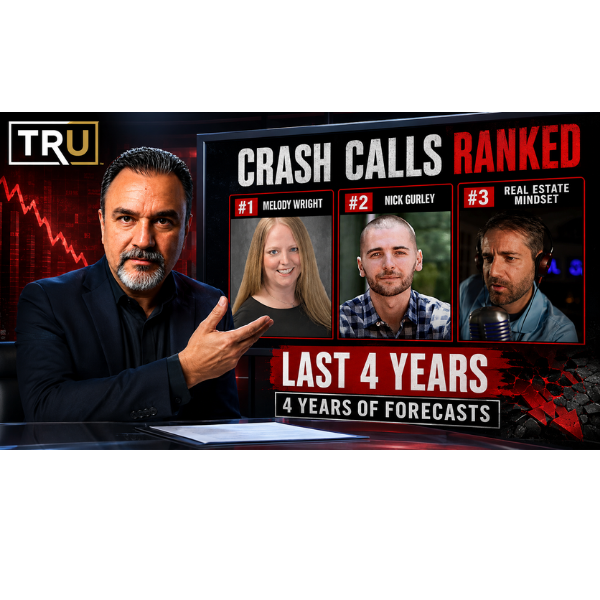
Top Real Estate Influencers Got Housing Wrong Since 2022 — And They’re Still Wrong

Top real estate influencers have been warning about a housing crash since 2022 — but the national collapse never showed up. In this deep dive, we look at how some of the loudest housing voices kept pushing crash predictions, affordability doom, unemployment fears, and market-collapse headlines while the actual data told a very different story. The question is simple: how did they get it this wrong, and why are they still saying it?

The Rate Update · Housing Forecast Accountability · 2022–2026

Top Real Estate Influencers Got Housing Wrong Since 2022 — And They’re Still Wrong

A compact four-year review of the three loudest housing-crash narratives: who pushed the doom case, how often they repeated it, and why the national crash call missed the actual data.

4-Year ReviewForecasts vs. DataTop 3 Crash Calls

The national crash never arrived.

Some local markets corrected. Some sellers cut prices. Buyers were crushed by payment shock. But the broad national housing collapse repeatedly promoted since 2022 did not show up.

The core mistake: confusing real affordability pain with a national price collapse.

0
National 2008-style housing crashes from 2022 through mid-2026
4
Years of repeated crash predictions reviewed
Local
Weakness was real in select markets
Payment
Mortgage rates drove most of the pain

Forecast Gap Score

Ranked from the worst miss to the least-worst of the Top 3.

🥇
Melody Wright / M3 Melody
100
🥈
Nick Gurley / Reventure
94
🥉
Real Estate Mindset
86
🥇

Melody Wright / M3 Melody

Gonzo Award Winner · Worst Overall Miss
Bottom line: the top miss because the forecast was specific, severe, and repeatedly framed as if a much deeper national housing break was coming.
Why this miss was bad

The issue was not one bearish video or one cautious opinion. The problem was the repeated certainty around a crash-style outcome: deep price declines, distressed sellers, affordability collapse, and a market supposedly much weaker than national data confirmed.

The repeated pattern

The message kept returning to the same story: buyers were trapped, sellers would capitulate, unemployment or stress would break demand, and housing remained on the edge of a major fall.

Verdict: real stress was treated like proof of national collapse.
🥈

Nick Gurley / Reventure

Data-Heavy Crash Narrative
Bottom line: ranked near the top because the crash case was delivered through charts, maps, affordability stress, inventory warnings, and repeated downside framing.
Why this miss was bad

The presentation often looked analytical, which gave the crash message more credibility. But data-heavy does not automatically mean accurate. If the conclusion keeps pointing to a national break and the market does not break nationally, the forecast still has to be graded.

The repeated pattern

The recurring message was that inventory, prices, affordability, mortgage demand, and regional weakness were lining up for a bigger housing downturn. Some weak markets were real. The national conclusion overshot the evidence.

Verdict: charts do not add up if the conclusion keeps missing.
🥉

Real Estate Mindset

Crash-Forward Housing Coverage
Bottom line: ranked third because the channel leaned heavily into housing weakness, unaffordability, buyer stress, and crash-forward framing.
Why this miss was bad

The strongest bearish points were tied to real issues: high payments, weak affordability, price cuts, buyer fatigue, and local inventory pressure. But the jump from “this market is stressed” to “housing is crashing” became too aggressive.

The repeated pattern

The coverage repeatedly emphasized the worst-case side: sellers under pressure, buyers priced out, layoffs, weak demand, and local markets supposedly pointing to something larger. Some local pain was correct. The national crash framing was not.

Verdict: useful caution became too crash-forward.

What buyers should learn

Payment beats panic. Buyers needed monthly payment math, not headline fear.
Local data matters. Weakness in some markets does not automatically mean national collapse.
Rates drove the pain. Mortgage rates, taxes, insurance, and total ownership cost mattered more than crash predictions.

The Rate Update Takeaway

The strongest forecast is not the loudest forecast. It is the one that separates affordability pressure from national price collapse.

Editorial note: This is an editorial forecast-accountability scorecard. It is not a personal attack, legal claim, investment advice, or a statement that every local housing market performed the same. Before broad publication, add clickable citations, screenshots, or source links for each public forecast reviewed.

The Rate Update with Dan Frio · One Application · One Credit Pull · Compare 30+ Lenders

Let us help you!

Our representative will be in touch with you.

* Specific loan program availability and requirements may vary. Please get in touch with your mortgage advisor for more information.