Election Results: Why the Winner Could Change Your Mortgage Rate
Mortgage rates today: what the midterm election results could mean for mortgage rates, bonds, stocks and your house payment, plus this week's economic calendar day by day. Watch today's show with Dan Frio.
THE RATE UPDATE MONDAY • WEEK AHEAD
NOVEMBER 2–6, 2026 • THE RATE UPDATE WITH DAN FRIO
THE ELECTION
Election outcomes first. Then the week’s biggest mortgage-rate movers.
For homebuyers, Realtors and loan officers: the few reports worth watching, the numbers economists expect, and a clear explanation you can use with clients.
Monday, November 2 show • Week of November 2–6, 2026 • Prepared November 1. Results are pending.
▶ WATCH TODAY'S SHOW · THE RATE UPDATE WITH DAN FRIO
Election Results: Why the Winner Could Change Your Mortgage Rate
Start with the policy surprise. Then watch the bond market’s reaction.
IF THEY CONTROL BOTH CHAMBERS
DEMOCRATS
Divided government with a Republican president.
↔
STOCKSMixed / sector rotation
Policy uncertainty can reshuffle winners. Gridlock may limit major legislative changes.
↗
BOND PRICESCould gain
Only if investors expect less borrowing or cooler inflation. Party control alone is not enough.
⌂
MORTGAGE RATESPossible relief
Lower bond yields could help—but mortgage pricing must actually improve.
IF THEY CONTROL BOTH CHAMBERS
REPUBLICANS
Unified control can make legislation easier.
↗
STOCKSPotential initial boost
Policy continuity may support sentiment. Higher bond yields could offset the benefit.
↘
BOND PRICESCould face pressure
If investors expect larger deficits and more Treasury borrowing, they may demand higher yields.
⌂
MORTGAGE RATESRisk of upward pressure
If bond yields rise on borrowing or inflation concerns, mortgage rates can follow.
BLUE + RED · SPLIT CONGRESS
Each party controls one chamber. Less room for major legislation; budget fights can still create volatility.
STOCKS↔ Mixed reaction
Earnings and interest rates regain center stage.
BOND PRICES↔ Data takes over
Watch inflation, jobs and Treasury supply.
MORTGAGE RATES⌂ No automatic drop
Friday’s jobs report can outweigh the political headline.
Conditional scenarios—not probabilities or guaranteed market moves. These are congressional elections; the presidency does not change. An expected result may already be priced in. Neither party guarantees smaller deficits. Results may take longer than election night.
FOLLOW THE MONEY • THE BOND–MORTGAGE CONNECTION
Why bond moves can change your mortgage rate.
Same relationship. Two directions. Watch which one the market takes.
UPWARD RATE PRESSUREWhen investors sell bonds and prices fall
01Bond prices ↓Selling pressure
➜
02Bond yields ↑Investors demand a higher return
➜
03Mortgage rates may rise ↑Less favorable lender pricing
POTENTIAL RATE RELIEFWhen investors buy bonds and prices rise
01Bond prices ↑Stronger demand
➜
02Bond yields ↓Investors accept a lower return
➜
03Mortgage rates may fall ↓Potentially better lender pricing
PRICE ↓YIELD ↑
Why do price and yield move opposite ways?
A fixed-rate bond’s promised payments stay the same. Pay less for those payments, and the yield rises; pay more, and it falls.
THE BUYER TAKEAWAY
A stock-market rally does not automatically mean a better mortgage rate. Watch bonds—and then your lender’s quote.
These are typical directional pressures, not a one-for-one rule. Mortgage-backed securities, lender margins and your loan details also affect pricing.
What this means for your mortgage
Watch bond yields after confirmed results. A stock rally does not automatically mean a better mortgage rate.
The takeaway before we move to the calendar
Party control changes policy expectations. The reaction in bonds tells us whether that creates relief or pressure for mortgage rates.
THE BACKDROP · THE FED RATE IS NOT YOUR MORTGAGE RATE
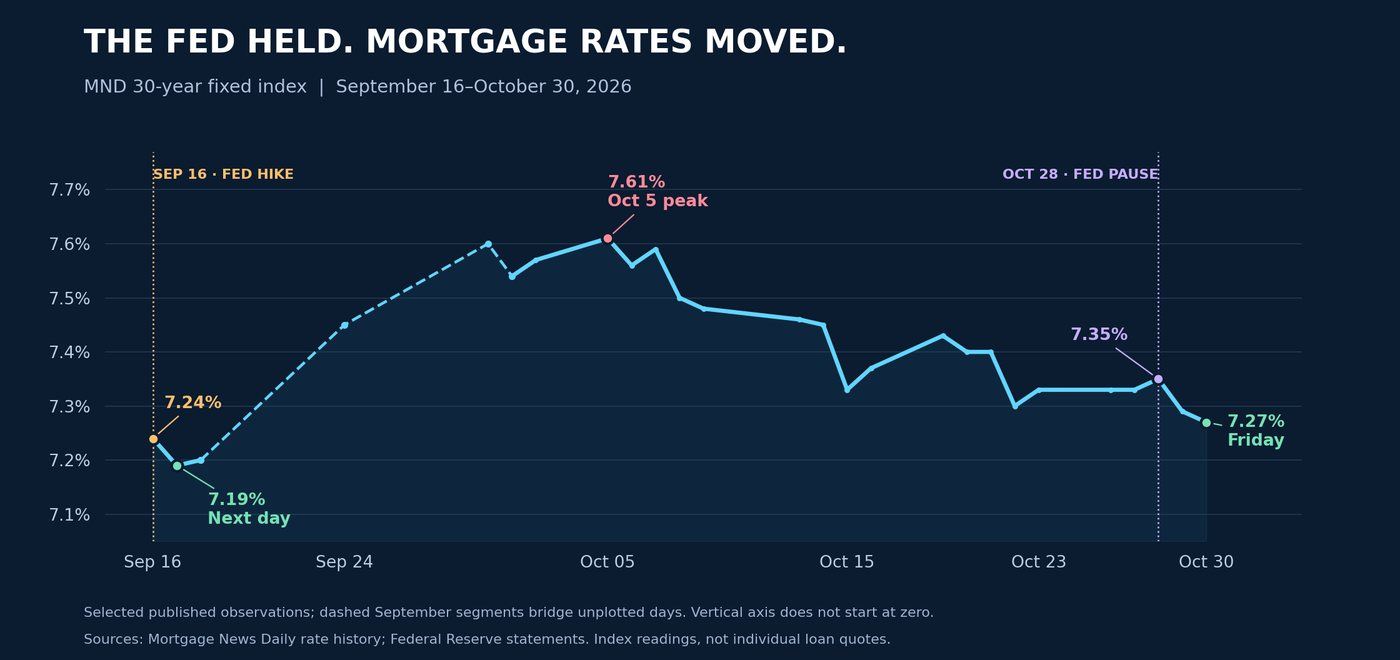
The Fed hiked. Mortgage rates still had room to fall.
September’s hike did not lock mortgage rates into an upward path. By Friday, October 30, the 30-year fixed index was 7.27%—down from October’s peak, with no Fed cut.
A higher Fed target did not prevent a next-day mortgage-rate decline.
OCTOBER PEAK TO FRIDAY7.61% → 7.27%↓ 34 basis points
Mortgage pricing improved while the Fed target stayed unchanged.
PAUSE DAY TO FRIDAY7.35% → 7.27%↓ 8 basis points
Rates fell after the pause; the Fed did not cut.
What this proves—and what it does not
Mortgage rates can fall after a Fed hike or during a pause. That does not prove the hike caused the decline. Friday’s 7.27% was still 3 basis points above September 16’s 7.24%.
Say it simply
“The Fed controls an overnight rate. Your mortgage follows the bond market’s view of what comes next. We don’t need a Fed cut for mortgage rates to improve.”
The numbers behind the chart
Date · 2026
What happened
MND 30-year fixed
September 16
Fed hike announced
7.24%
September 17
Day after the hike
7.19%
October 5
Peak in the displayed period
7.61%
October 23
Friday before the pause week
7.33%
October 28
Fed pause announced
7.35%
October 29
Day after the pause
7.29%
October 30
Friday’s final daily index
7.27%
Friday-to-Friday: down 6 basis points. Mortgage rates rose 2 basis points on pause day itself, then fell Thursday and Friday. One basis point is 0.01 percentage point.
Sources: MND daily history; September daily readings; Federal Reserve September 16 and October 28 statements. Verified November 2. “Friday” refers to MND’s final daily index, not a tradable closing price. Same index throughout; no mixing of daily and weekly surveys.
How to read this week: “Previous” is the last reading. “Economists expect” is the forecast to beat or miss. A surprise can move rates more than the headline alone.
All times Central. Forecast snapshot: November 1, from the Investing.com calendar displayed on Bloomberg. No consensus means no estimate was established. Monday is a preview; actual results are not available yet.
MONDAY · NOV 2 · 3 KEY ITEMS
Will business costs keep rates high?
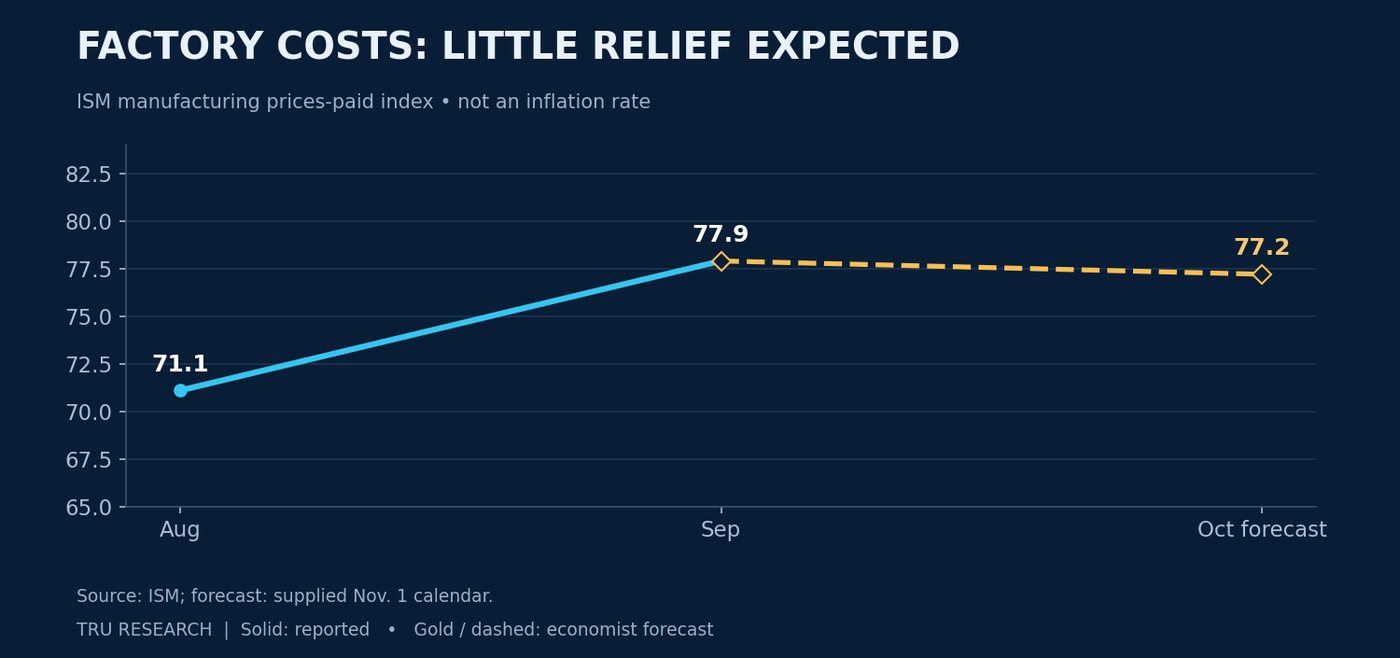
Economists expect only a small dip in prices paid. Watch whether the actual report delivers more relief.
TOP WATCH · FACTORY INFLATIONPrices paid: 77.9 → 77.2 expected
A larger drop could ease rate pressure. Also watch Treasury borrowing.
Time CT
What we’re watching
Previous
Economists expect
9:00 a.m.
Factory activityISM Manufacturing PMI · Oct
54.5
54.7
9:00 a.m.
Factory input costsISM Manufacturing prices paid · Oct
77.9
77.2
2:00 p.m.
Government borrowingTreasury Q4 net estimate update
$628bn*
No consensus
*Treasury previous = August’s Q4 borrowing estimate, not actual borrowing. PMI and prices-paid readings are indices, not inflation percentages.
What this means for your mortgage
A bigger-than-expected fall in costs could help bonds and mortgage pricing. Hotter costs or heavier borrowing could push the other way.
THE RATE UPDATE VIEW
Watch prices first, then the headline PMI. Our view stays near consensus on growth, with a risk that costs remain sticky.
One sentence for a buyer or client
“We’re watching whether business costs are easing enough to take pressure off mortgage rates.”
TUESDAY · NOV 3 · 2 KEY ITEMS
Job openings first. Election results that evening.
The morning’s JOLTS report tests hiring demand. That evening, revisit the election scenarios above as congressional results become clear.
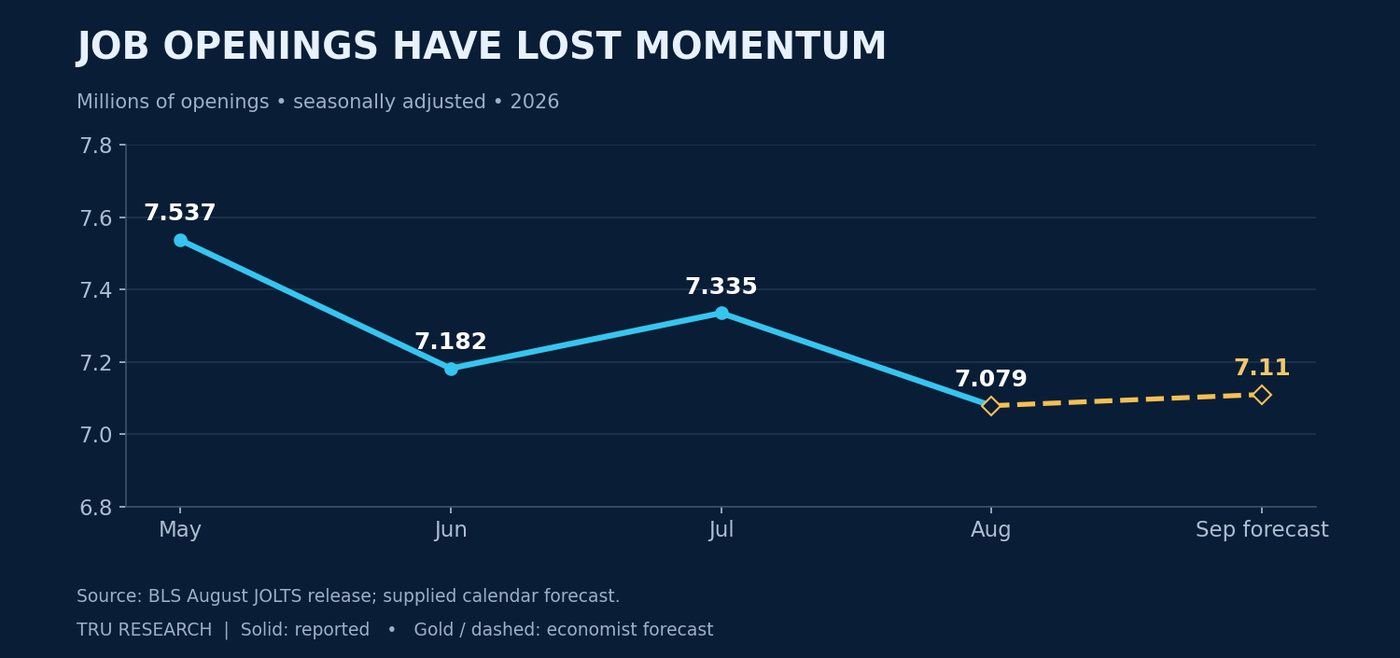
TOP WATCH · ELECTION DAY + JOB OPENINGSJOLTS: 7.079m → 7.110m expected
Morning hiring demand; congressional results later. The election scenarios lead this show.
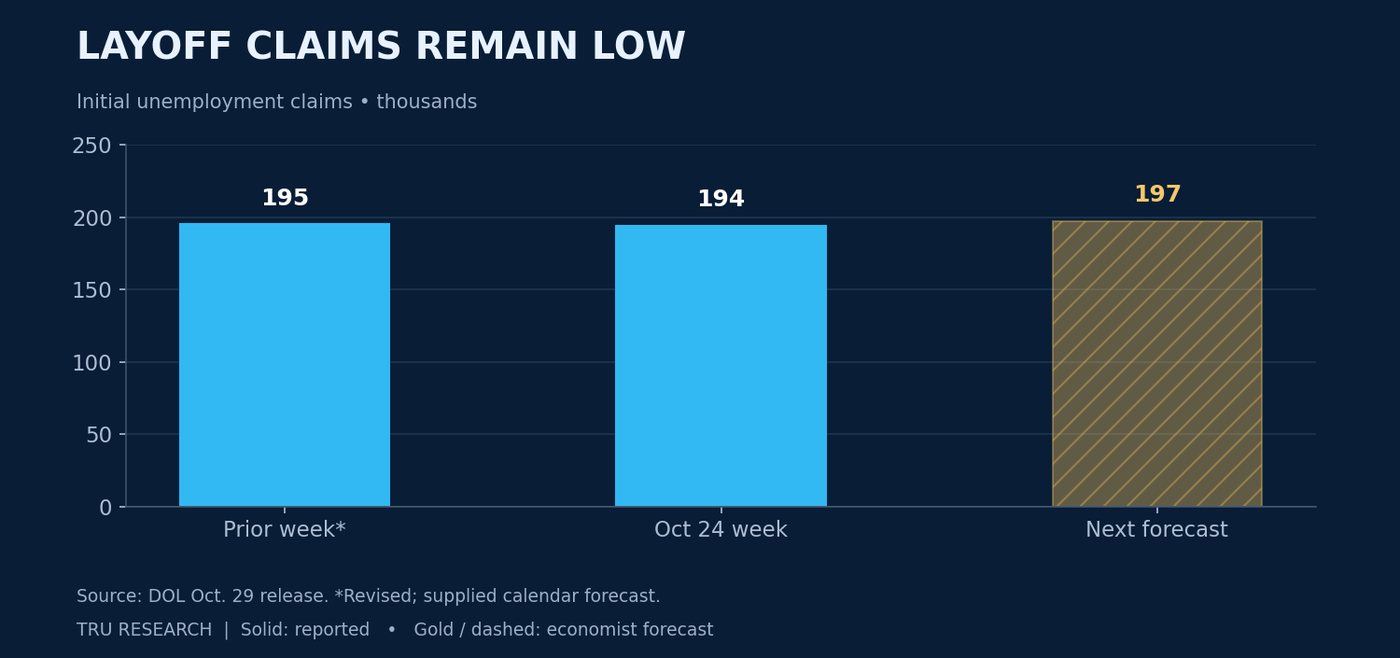
Openings near 7.1 million look reasonable. A softer result would fit the recent trend, but limited layoffs argue against assuming a labor-market collapse.
One sentence for a buyer or client
“The election matters through expected policy and borrowing; the bond market will tell us how lenders may respond.”
WEDNESDAY · NOV 4 · 4 KEY ITEMS
Can slower hiring overcome sticky inflation?
The market expects slower hiring and slightly slower services growth. The question is whether costs ease too.
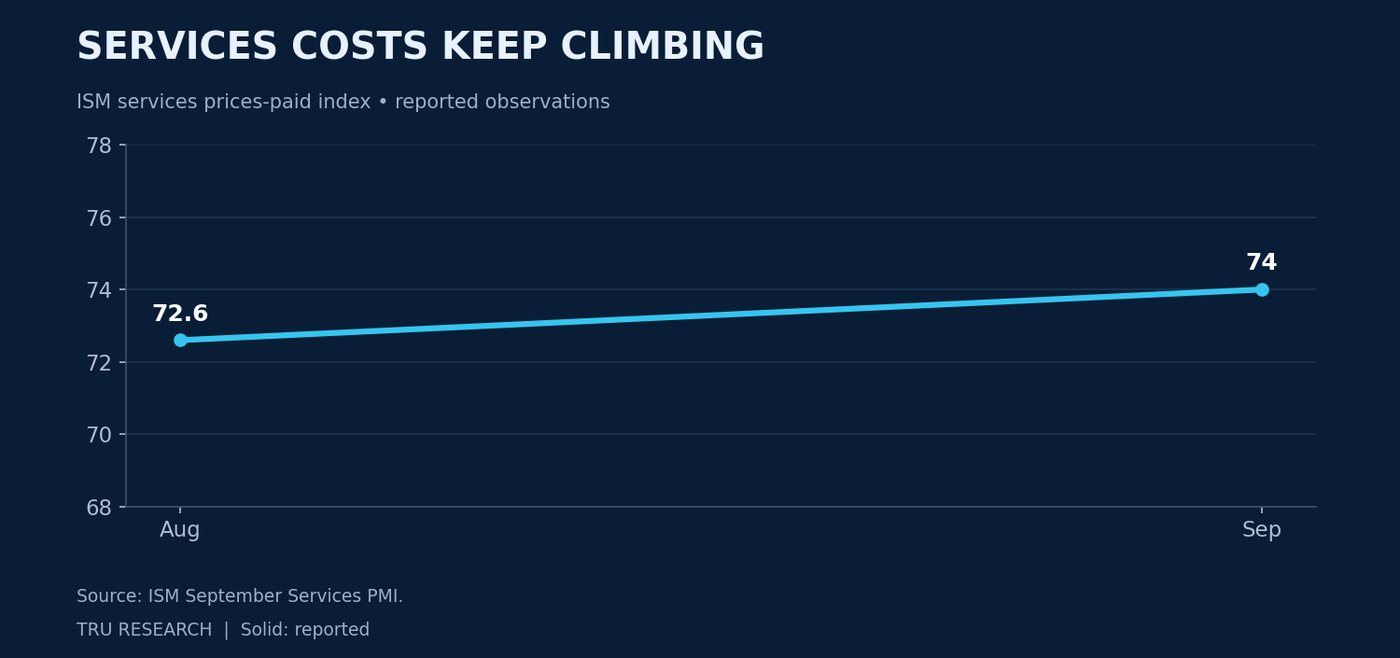
TOP WATCH · SERVICE-SECTOR COSTSPrevious: 74.0 · No consensus forecast
Watch inflation pressure alongside ADP hiring and Treasury’s financing plan.
Time CT
What we’re watching
Previous
Economists expect
7:15 a.m.
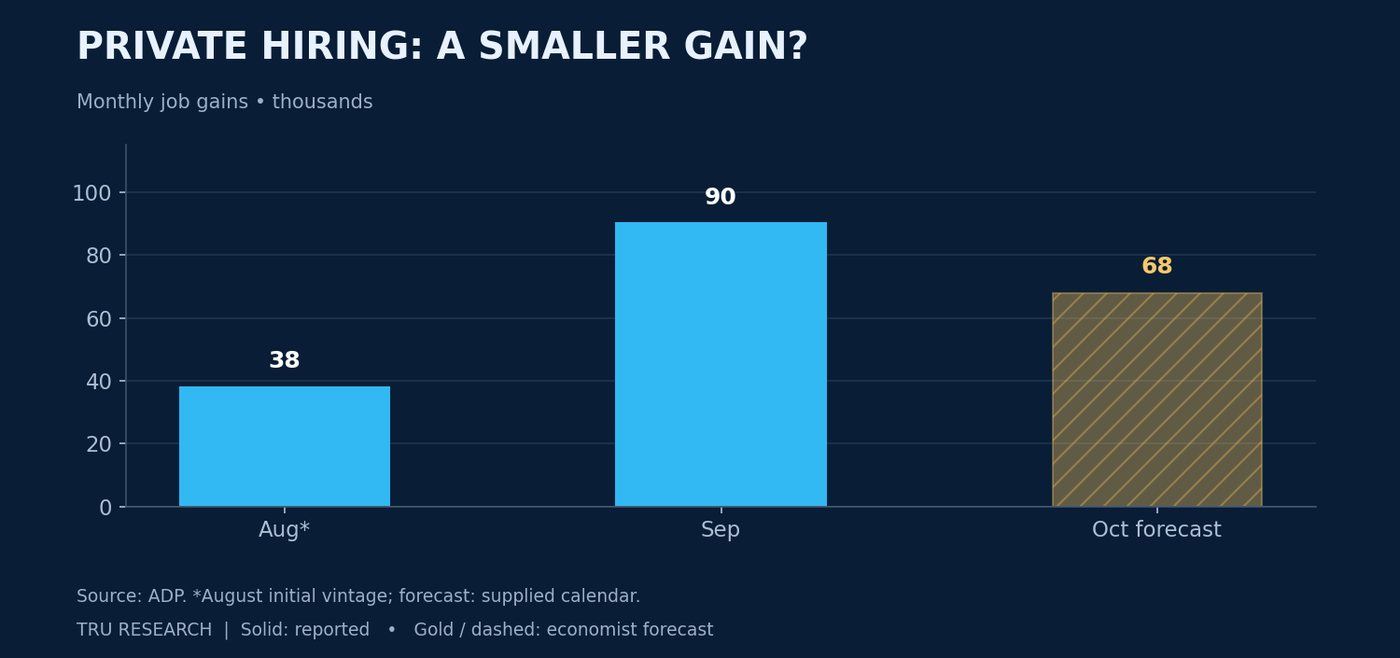
Private-sector hiringADP · Oct
90k
68k
7:30 a.m.
Treasury financing planQuarterly refunding
Prior plan*
No consensus
9:00 a.m.
Service-sector growthISM Services PMI · Oct
54.9
54.8
9:00 a.m.
Service-sector costsISM Services prices paid · Oct
74.0
No consensus
*Prior new-issue plan: $58bn 3-year / $42bn 10-year / $25bn 30-year. Watch changes to issuance sizes, not just the total borrowing headline.
What this means for your mortgage
Cooler hiring AND cooler prices are a cleaner signal for lower rates. Sticky prices can cancel out the benefit of slower growth.
THE RATE UPDATE VIEW
ADP consensus already assumes cooling. We lean toward persistent service-sector cost pressure; watch for a genuine downside surprise before calling inflation relief.
One sentence for a buyer or client
“Slower hiring helps the rate outlook most when inflation pressure cools at the same time.”
THURSDAY · NOV 5 · 3 KEY ITEMS
Can inflation ease without more layoffs?
If workers produce more per hour, wages can rise without costs per unit rising as quickly.
Read jobs, wages and unemployment together. Then check whether inflation expectations reinforce the morning’s reaction.
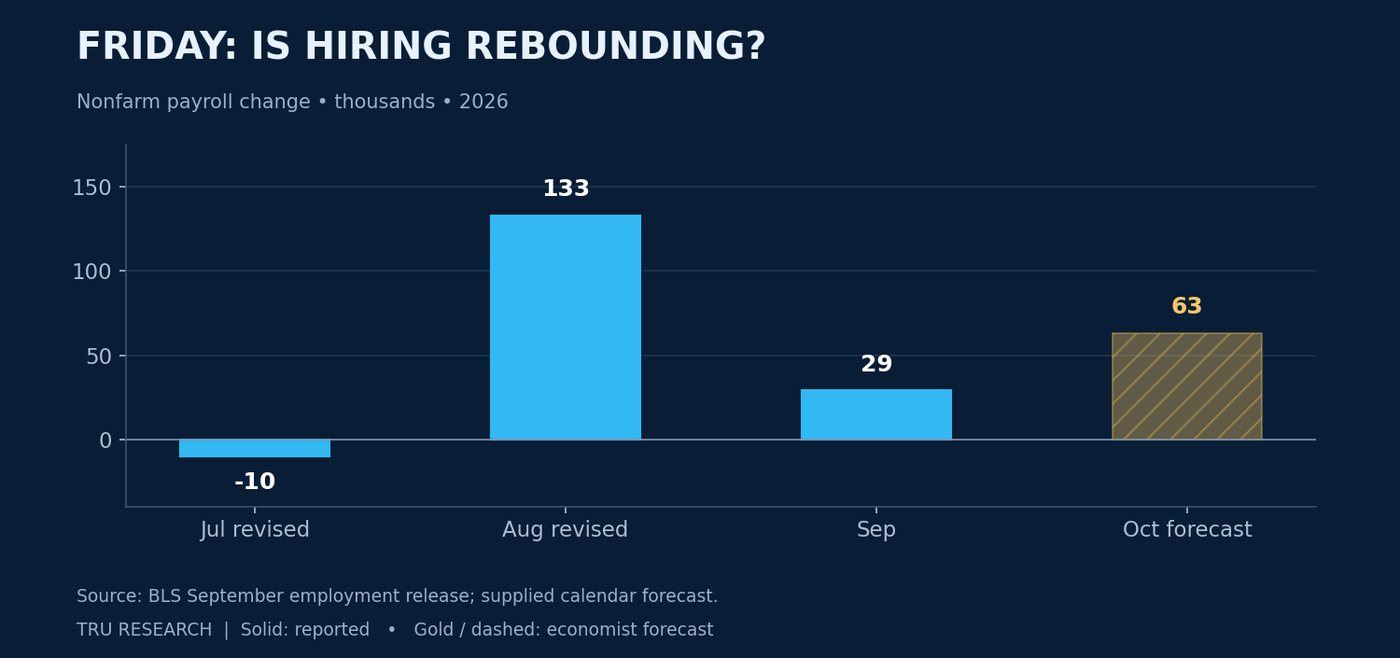
TOP WATCH · THE JOBS REPORTPayrolls: 29k → 63k expected
Read jobs, wages and unemployment together—the week’s biggest scheduled data test.
Time CT
What we’re watching
Previous
Economists expect
7:30 a.m.
Jobs addedNonfarm payrolls · Oct
29k
63k
7:30 a.m.
Unemployment rateBLS household survey · Oct
4.2%
4.2%
7:30 a.m.
Monthly wage growthAverage hourly earnings · Oct
0.1%
0.3%
9:00 a.m.
Longer-run inflation expectationsMichigan survey · Nov preliminary
3.5%
No consensus
What this means for your mortgage
Softer hiring with cooler wages would generally help bonds. Weak jobs plus persistent inflation make the rate outlook less clear.
THE RATE UPDATE VIEW
Our low-confidence payroll working view is about 50k versus 63k consensus, based on the roughly 50.7k July–September average. Low claims and resilient output could make that view too soft.
One sentence for a buyer or client
“We’ll compare the actual jobs and wage numbers with expectations, then check whether lenders improve pricing.”
WHAT HOME BUYERS SHOULD DO WITH THIS
Watch the combination—not one headline.
More favorable for rates
Softer jobs + cooler prices + manageable bond supply.
Upward rate pressure
Hot wages + persistent inflation + heavier long-term issuance.
Mixed / volatile
Weak hiring with high costs, or unresolved election uncertainty.
At $400,000 over 30 years, 7.00% is about $2,661/month; 7.25% is about $2,729/month in principal and interest.
Illustration only; excludes taxes, insurance, mortgage insurance and fees. Rate and lock decisions depend on your loan, closing date and risk tolerance.
MONDAY: What we expect. FRIDAY: What happened—and what it means.
Friday’s week-in-review scorecard
Friday, we’ll revisit these same 16 selected items. We’ll add actuals beside the original forecasts, identify revisions, and show the observed bond-market and mortgage-pricing response. The question: what changed for a buyer since Monday?
Difference = actual minus forecast, in the same units. A positive difference is not automatically good or bad: higher claims and higher inflation have very different meanings. If a forecast is missing, show “not available.”
Watch the full show + get your own numbers
Election Results: Why the Winner Could Change Your Mortgage Rate
Dan Frio | NMLS #246527 | PBT Bancorp | NMLS #257781 | Equal Housing Lender | 524 Main St, Hazard, KY 41701. Dan Frio is a federally registered mortgage loan officer with PBT Bancorp. Mortgage products are originated by PBT Bancorp, NMLS #257781. Payment examples are principal and interest only and are for illustration, not a quote. This content is educational and not a commitment to lend.
* Specific loan program availability and requirements may vary. Please get in touch with your mortgage advisor for more information.