MONEY QUESTION LAB DOCUMENTARY · WITH DAN FRIO
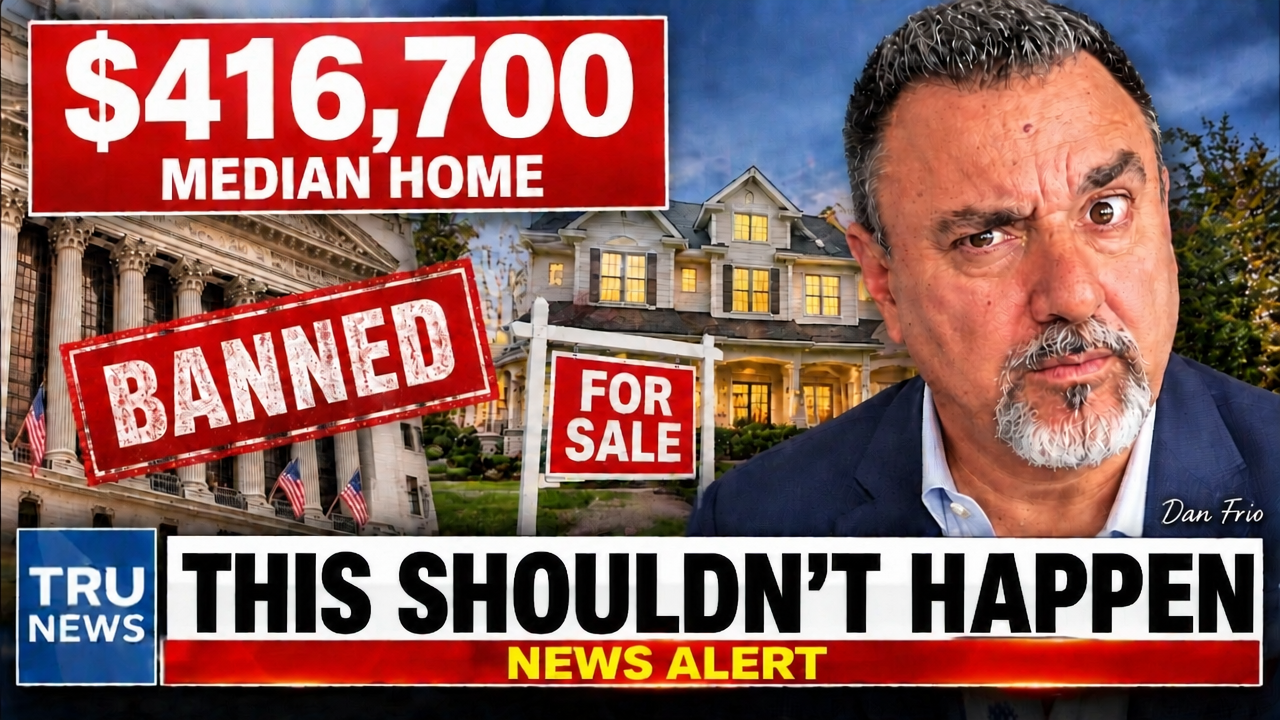
Realtor.com put the national median list price at $415,000 in October 2026, down 2.2% from a year earlier but up 33.9% since 2019. NAR’s median sale price was $416,700, its 40th straight month of yearly gains, while existing-home sales fell to a 16-year low.
Section 1001, titled “Homes are for people, not corporations,” bars any entity with investment control of 350 or more single-family homes from buying more. Penalties reach $1 million per violation or 3× the price. The 11 exceptions include build-to-rent, renovate-to-rent, buying from other large investors, buying from small investors for two years, foreclosures and senior living.
“Decreasing Housing Costs for the American People” directs FHFA to consider a PMI pilot for new loans, a title insurance waiver on refinances, lower rates on USDA and VA direct loans, and a factory-built housing task force due in 180 days. The PMI and refinance pieces apply only “if he determines it is appropriate.”
Illinois has banned local rent control since 1997. SB1260 (filed Jan. 28, 2025) would repeal that ban in one sentence; SB2884 (Jan. 2026) would let home-rule cities share the power. Stanford research on San Francisco found covered landlords cut rental supply 15% and citywide rents rose about 5.1%.
“Big money doesn’t break the law. It reads the exceptions.” After 38 years in lending, Dan’s view is that these fixes move money around but don’t build homes, and building permits hit a 3½-year low in September 2026. If you’re buying now, get your credit and pre-approval ready; if you have PMI, you may be able to drop it today.
Book a free call with Dan Check your free VantageScore →
Probably not by much. Companies with 1,000+ homes hold about 2.2% of investor-owned homes, the ban has 11 exceptions including build-to-rent, and no investor has to sell homes it already owns. Prices are driven mostly by supply, and building permits hit a 3½-year low in September 2026.
January 7, 2027. It applies to entities controlling 350 or more single-family homes and sunsets after 15 years.
It directs FHFA to consider a mortgage insurance (PMI) pilot for new loans, title insurance waivers on refinances, lower rates on USDA and VA direct loans, and a factory-built housing task force. Only the task force has a deadline (180 days).
Yes. On a conventional loan you can request removal at 20% equity, and it drops automatically at 22%. If your home has risen in value, an appraisal can prove equity sooner.
It helps tenants already in place, but a Stanford study of San Francisco found covered landlords cut rental supply 15% and citywide rents rose about 5%. Illinois has banned local rent control since 1997; repeal bills are pending.
An IHDA program launched Dec 1, 2020 that paid 15% of the price, up to $40,000, toward a buyer's student loans plus $5,000 for down payment. The 2024 round closed in under three months after helping 533 buyers.
On July eleventh, Washington passed the biggest federal housing law in decades, and it bans Wall Street from buying single family homes. In October, the White House followed with an executive order called, Decreasing Housing Costs for the American People. And here in Illinois, rent control is back on the table. Big headlines. Big promises. So the question is simple. Will any of it actually help? Will it make a home affordable for you? We'll read the actual bills, see how the headlines played them, and then I'll give you the TRU News take. Let's investigate.
I'm Dan Frio. I grew up in a steel town in West Virginia, came to Chicago with my last twenty five hundred dollars, and I've spent thirty eight years in the mortgage business. In that time I've watched every kind of housing fix come and go. This channel exists for one reason: to help you go from victim to victor by learning how money truly works. You ask. We investigate.
And this isn't the first time I've been asked about housing affordability. NewsNation asked me about the fifty year mortgage. My answer? A savings of a hundred fifty to two hundred dollars isn't really fixing the problem. Yahoo Finance asked me about the fight over the Fed, and what happens if mortgage rates go up to eight percent. And Homes.com has interviewed me as rates moved, from dipping under six percent, to climbing to a three year high. Different headlines. Same problem. The monthly payment.
To know if it will help, start right here in Illinois. In December of 2020, the state made an offer that sounded too good to be true. Buy a home here, and we will pay off up to forty thousand dollars of your student loans. Free money. People drove in from other states to get it. And then, just like that, the money was gone. Feast... and then famine.
Exhibit A. Illinois SmartBuy. It launched on December first, 2020, with a twenty five million dollar fund. It paid fifteen percent of the purchase price, up to forty thousand dollars, to wipe out a buyer's student loans, plus five thousand dollars toward the down payment or closing costs. The forty thousand was a forgivable note. Live in the home for three years, and it's gone. You needed a six forty credit score, and your debt to income couldn't go above forty five percent. And it worked, for the people who got in. When the program came back in December of 2024, reservations closed in less than three months. That round helped five hundred thirty three buyers erase sixteen million dollars in student debt, about twenty nine thousand dollars each. Across both rounds, eleven hundred sixty new homeowners. That's real help. But here's the catch. Illinois has more than two million people carrying student loans. A program that sells out in twelve weeks isn't a housing policy. It's a lottery ticket.
The TRU News take on SmartBuy. From the lending side, here's the pattern I've seen with every program like this. When there's a big pot of money and a deadline, buyers rush in, sellers know it, and prices get bid up. Then the money's gone, and the next family pays the higher price without any help. For the people who got in, it was real money and a real home. But if Illinois wants to help young buyers, a steady, smaller program every single year beats a giant one that sells out in twelve weeks. Feast and famine helps the few who get there first.
To understand today's plan, you have to see the pattern. When housing gets too expensive, government steps in with a fix. In 2008 and 2009, it was the first time homebuyer tax credit. Up to eight thousand dollars to buy a home. Buyers rushed in before the deadline, and when the credit expired in 2010, sales fell right back down. Then in 2020 and 2021, mortgage rates hit record lows. Fear of missing out took over. Home prices jumped, and when rates doubled, the door slammed shut on a whole generation of buyers. Feast, then famine. The fix usually helps someone pay for a house. It rarely creates a house. Keep that in mind, because it's the key to everything that follows.
So where do home prices stand right now? According to Realtor.com, the national median list price in October was four hundred fifteen thousand dollars. That's down two point two percent from a year ago, the twelfth straight month of yearly declines. But it's still up almost thirty four percent from 2019. The National Association of Realtors says the typical home actually sold for four hundred sixteen thousand seven hundred dollars, its fortieth straight month of yearly gains. And existing home sales fell to their lowest level in sixteen years. Prices are barely budging, and buyers are stuck on the sidelines.
Fast forward to October twenty second, 2026. The President signs an executive order called Decreasing Housing Costs for the American People. First, understand what an executive order is. It's a to do list for federal agencies. It is not a law. This one runs through the Federal Housing Finance Agency, which oversees Fannie Mae and Freddie Mac. It has four parts. Part one, a pilot to drop private mortgage insurance sooner, using computer home values. But it only covers loans made after the pilot starts, and the equity requirement hasn't even been named. Part two, refinances could skip the lender's title insurance policy, by making an existing pilot permanent. Part three, lower rates on two direct loan programs, USDA direct loans and V A loans for Native American veterans on trust land. Most V A and USDA borrowers use a regular lender, so they won't see a change. And part four, a task force on factory built homes, with recommendations due in about one hundred eighty days. Notice what's missing. Nothing here changes home prices. Nothing changes your mortgage rate. And most of it has no start date.
Let's read the order itself, in its own words. Section one opens with this line: The American Dream of homeownership is a vital pillar of our great country. Now listen to how the working parts are written. Section two says the FHFA director shall, if he determines it is appropriate, direct Fannie and Freddie to set up a mortgage insurance pilot. And it applies only to mortgages made after the pilot is established. Section four, on title insurance, uses the same words: if he determines it is appropriate. And on skipping appraisals and income checks for refinances, the director only shall consider it. The one hard deadline in the entire order is in Section three. The manufactured housing task force reports back within one hundred eighty days. Everything else? No date at all.
So how did the headlines play it? Bloomberg's story, carried by Insurance Journal, ran: Trump Signs Executive Order Aimed at Taming Housing Costs. It noted the order came in the final sprint to the midterm elections, the same week building permits, housing starts and pending sales all came in weaker than expected. Local TV stations across the country ran it simply as: Trump signs executive order lowering housing costs. But the real estate trade press was cooler. RISMedia's headline: New Trump Order Aims to Cut Housing Costs, With Mixed Reaction From Industry. One mortgage company CEO told them, nothing in this executive order is adding an enhanced value to help affordability today.
Here's the TRU News take. After thirty eight years, I read an executive order the same way I read a loan estimate. Skip the headline, and go straight to the fine print. And the fine print here says, if appropriate. Shall consider. Only after the pilot starts. That's not a price cut. That's a maybe. Is any of it bad? No. Cheaper refinances and automatic mortgage insurance removal are good ideas. But if you're a buyer sitting on the sidelines, waiting for this order to lower your payment, don't. Your payment is set by the price, the rate, your down payment, and your credit. None of those changed on October twenty second.
Here's something most people don't realize. You can already get mortgage insurance removed today. On a conventional loan, once you reach twenty percent equity, you can ask to drop it, and it falls off automatically at twenty two percent. If your home has gone up in value, an appraisal can prove it sooner. On a three hundred fifty thousand dollar home with five percent down, mortgage insurance at half a percent to one and a half percent a year runs roughly one hundred forty to four hundred sixteen dollars a month. That's money you can go after right now, without waiting for any pilot.
Exhibit C is bigger, because it's an actual law. The Twenty First Century ROAD to Housing Act became law on July eleventh, 2026. Section ten oh one carries a title that says it all. Homes are for people, not corporations. Starting January seventh, 2027, any company that controls three hundred fifty or more single family homes is banned from buying more. Break the rule, and the penalty can reach one million dollars per violation, or three times the purchase price. Sounds tough. Now read the fine print. There are eleven exceptions. Build to rent. Renovate to rent. Buying from other big investors. Buying from small investors for about two more years. Foreclosures. Senior living. And homes bought under an exception don't count toward the three hundred fifty home limit. Most important, nobody has to sell a single house they already own. An earlier Senate version would have forced investors to sell new rentals within seven years. That requirement didn't make the final law.
Now let's read the actual law. It's Public Law one nineteen, one oh one. The Twenty First Century ROAD to Housing Act. Title Ten is called Homeownership for Main Street America, and Section ten oh one is titled, Homes are for people, not corporations. Here's how it defines a large institutional investor. A for-profit entity, like an investment fund, corporation, partnership, LLC or joint venture, that alone or with related entities has investment control of at least three hundred fifty single family homes. And here's a key detail. Homes bought through an exception after the law passed don't count toward that number. The prohibition itself is simple. No large institutional investor may purchase, or contract to purchase, directly or indirectly, any single family home. Then come the eleven excepted purchases. New construction for sale. Build to rent. Renovate to rent. Homeownership programs. Boost homeownership programs. Debt satisfaction and repossession. Mortgage servicing and loss mitigation. Purchases from other large investors. Purchases from smaller investors, for two years. Senior living communities. And combination purchases. Big landlords must also tell their renters about a new HUD help line, and report to HUD how many homes they own in each city. The ban starts January seventh, 2027, and it sunsets after fifteen years.
So how big are the giant investors, really? According to BatchData, investors bought about twenty seven percent of homes sold in the second quarter of 2026. That sounds huge. But most of those buyers are small, mom and pop investors. Companies with a thousand homes or more hold only about two point two percent of all investor owned homes. And investor share rises when regular buyers step back, and falls when they return. In other words, the big funds were already pulling back. And the law hands them a door marked build to rent. Instead of buying your neighbor's house, they can build an entire rental subdivision. That's a home you can rent, but never buy.
So what did the headlines say? When the Senate passed the bill eighty nine to ten, Bloomberg Law framed it as a housing supply bill that set up a showdown in the House over the investor ban. Fortune ran: Banning institutional investors from buying homes will backfire for many Americans, experts say. The rental home industry's trade group told Fortune a ban could reduce rental supply and displace more than a million people. Then the law passed, and the tone changed. Bloomberg: Wall Street Landlords Escape Worst of Trump Threats With New Law. The Real Deal: Wall Street landlords find wiggle room in new US housing law. And in October, Bloomberg Government: Treasury Unveils Rule to Ban Large Investors From Homebuying, with the ban set to start January seventh.
Here's the TRU News take. I've financed investors for thirty eight years, and I can tell you how this goes. Big money doesn't break the law. It reads the exceptions. Build to rent is wide open, so the funds will build entire neighborhoods of rentals. Homes your kids can rent, but never buy. Is the ban a start? Yes. It sends a message, and the reporting rule means we'll finally see who owns what, city by city. But the biggest investors were already a small slice of the market, and they keep every house they own today. If you want to beat Wall Street, don't just block the buyer. Build more homes than they can buy. And if you're shopping right now, the competition you're really up against is a local investor with cash, not a hedge fund. So get your credit and your pre approval ready, so you can compete.
Exhibit D. Rent control. Since 1997, Illinois law has banned cities from passing rent control. Bills to repeal that ban keep coming back, including one filed in 2025 and another in January of 2026. On paper, rent control sounds like the most direct fix there is. Cap the rent, protect the tenant. So what happens in real life? The best evidence comes from Stanford economists who studied San Francisco after the city expanded rent control in 1994. Tenants who were already in place stayed put, and many avoided being pushed out of the city. That's the benefit, and it's real. But landlords covered by the law cut their rental supply by fifteen percent. They converted to condos, sold to owners, or tore down and rebuilt. Citywide rents rose about five percent. The renter already inside won. The next renter paid more.
Here's the actual Illinois bill. Senate Bill twelve sixty, filed January twenty eighth, 2025, by Senator Graciela Guzmán. The working text is one sentence. Section five. The Rent Control Preemption Act is repealed. It has been sitting in the Senate Assignments committee ever since. A second bill, Senate Bill twenty eight eighty four, filed in January 2026, would let home rule cities share that power with the state. Supporters, including tenant advocates, say local governments need the tools to protect renters in high cost areas. On the other side, Illinois Realtors, who helped pass the 1997 ban, put out a capitol report headlined: Rent Control Is Back. They warned it would cause disinvestment and less rental housing.
From my side of the desk, here's why that happens. An investor buys a building for two things. Cash flow, and tax benefits, mainly depreciation, which on residential property is written off over twenty seven and a half years. Cap what that owner can charge, and once those benefits are used up, the math stops working. Maintenance gets put off. Units get converted. Or the owner sells and walks away. The building gets older, the supply gets smaller, and the people looking for a place to live pay the price. As always, talk to a tax professional about your own situation.
So what's the real problem? Supply. In September of 2026, single family housing starts fell four point six percent, and building permits dropped to their lowest level in three and a half years. Every fix we've looked at today moves money around. Tax credits, student loan payoffs, insurance waivers, purchase bans, rent caps. None of them builds homes this year. When you give buyers more money without more homes, you mostly get higher prices. That's the feast. Then the money runs out. That's the famine.
The headlines on supply tell the same story. When the September numbers came out, Bloomberg reported that building permits, housing starts and pending sales all came in significantly lower than economists expected. Back in January, when the first Wall Street order came out, Reuters reported investors warning it could boost demand while doing little to fix the tight supply that drives prices higher. And Fox Business ran: Effort to rein in Wall Street landlords could push US home prices up, investors say. Different outlets, same conclusion. Without more homes, the math doesn't change.
So, will the new housing rules make homes affordable? Here's what the evidence says. The executive order could save some homeowners money on refinances and mortgage insurance someday, but it has no start date and doesn't touch prices or rates. The Wall Street ban is a start, and it sends a message, but the biggest investors were already a small slice of the market, and the exceptions leave plenty of room. And rent control helps the tenant in the unit today, while the evidence shows it shrinks supply for everyone else. Your monthly payment still comes down to four things. The price, the rate, your down payment, and your credit. Those are the levers you control, and they matter more than any headline.
If this helped you understand what's really happening in housing, subscribe to Money Question Lab, and leave your money question in the comments. Your question could be our next investigation. I'm Dan Frio. You ask. We investigate.
Sources: P.L. 119-101; White House EO (Oct 22, 2026); ilga.gov (SB1260, SB2884); IHDA; Realtor.com; NAR; NAHB; BatchData; Diamond, McQuade & Qian (AER 2019); Holland & Knight; Bloomberg; Fortune; The Real Deal; RISMedia; Reuters; Fox Business.
Dan Frio | NMLS #246527 | PBT Bancorp | NMLS #257781 | Equal Housing Lender | 524 Main St, Hazard, KY 41701. Mortgage products are originated by PBT Bancorp, NMLS #257781. This page is for general information only and is not a commitment to lend, an offer of credit, or legal or tax advice.