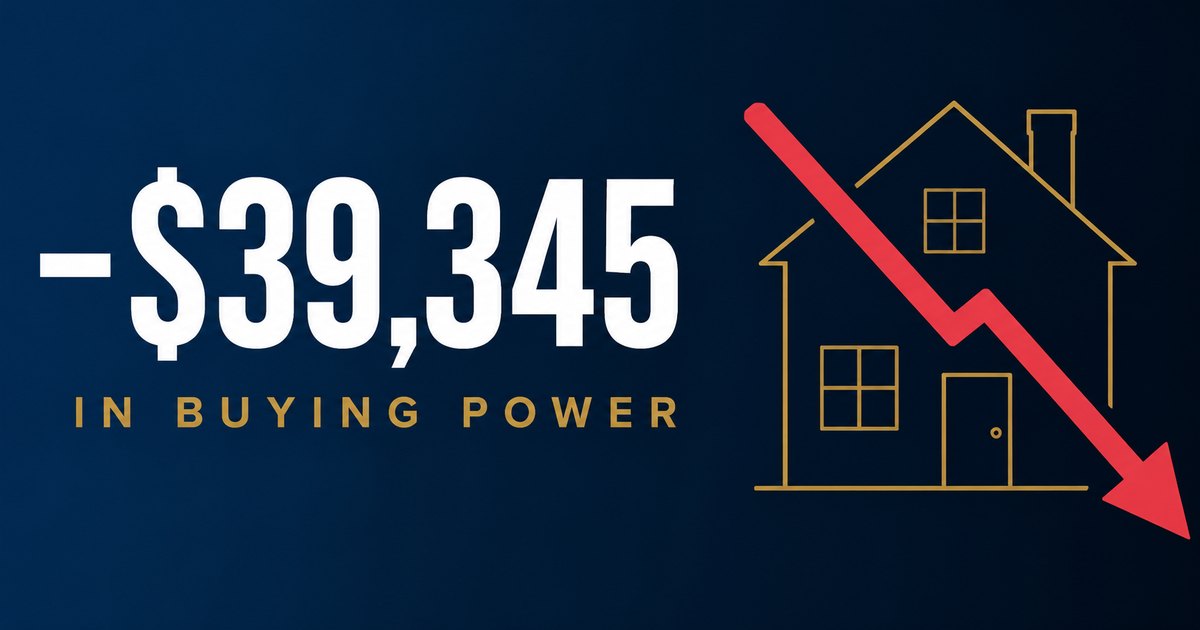
A move of less than one percentage point can erase nearly $40,000 of home-buying power. Here is the math — and what must change before rates meaningfully retreat.
5.99% → 6.90%
Working market-rate comparison: immediately before the Iran conflict versus today's borrower quote.
The latest NAR median existing-home price is $434,100. For a clean comparison, this report assumes 20% down, a $347,280 30-year fixed loan, and principal-and-interest payments only. If you want the longer explanation of why the 5.99% market is not simply coming back, I broke that down in The Math Behind Mortgage Rates: Why 5.99% Isn't Coming Back Yet.
| Rate | Monthly P&I | Difference vs. 5.99% | 30-year interest* |
|---|---|---|---|
| 3.99% | $1,656 | −$424 | $248,868 |
| 5.99% | $2,080 | Baseline | $401,479 |
| 6.90% today | $2,287 | +$207 | $476,107 |
| 7.00% | $2,310 | +$231 | $484,487 |
| 7.79% Freddie Mac 2023 peak | $2,498 | +$418 | $551,843 |
| 8.20% borrower example | $2,597 | +$517 | $587,569 |
*Illustrative interest if the original balance remains outstanding for all 360 scheduled payments; excludes taxes, insurance, HOA, mortgage insurance, points and closing costs.
At 5.99%, the median-home loan costs about $2,080 per month. Holding that payment and 20% down constant shows how rising rates compress purchasing power. You can reproduce any of these numbers with your own price, down payment and taxes using the mortgage calculators, and I walked through the 7% version of this exercise in Mortgage Rates Could Hit 7%: Here's How Much House You'll Lose.
The practical takeaway: the move from 5.99% to 6.90% cuts purchasing power by about 9.1%. A move to 7.00% would make it nearly 10%. If you are early in the process, get a real payment ceiling first — start with a pre-qualification or, if you would rather do it yourself, run it through the DIY Mortgage path and see live pricing without a phone call.
A 6.90% refinance would raise the illustrative payment about $631 per month on the same balance. There is usually no rate-and-term reason to refinance unless cash flow, term, equity access or debt consolidation changes the larger equation — the cases where it still makes sense are laid out in Refinancing Isn't Just About the Rate.
Moving the same illustrative balance to 6.90% lowers P&I about $310 per month, or roughly $3,715 per year. Closing costs and your actual remaining balance decide whether it pays — see when a refinance makes sense and when it doesn't, then compare options on the refinance page.
Every 0.25-point improvement near today's range saves roughly $58–$60 per month on this loan size. Buying that improvement has a cost of its own — how mortgage points work. Do the break-even math; do not wait for an arbitrary “perfect” rate.
A refinance starts a new amortization schedule unless you choose a shorter term. Compare total cost, cash recapture period and expected time in the home — not only the monthly payment. Related: Refi Reality Check: Save Now, Win Again If Rates Fall.
Oil is a catalyst, not a direct mortgage-rate dial — I tracked that relationship in Mortgage Rates vs. the Iran War: What the Market Data Reveals and why homebuyers need to watch oil prices now. Rates also reflect labor data, inflation reports, the expected Fed path, federal borrowing, global bond yields and investor demand for mortgage-backed securities. That is why we watch the 10-year Treasury instead of the Fed funds rate, and why the Fed is not the biggest problem in this cycle. As of September 2, the 10-year Treasury was around 4.79%, while crude traded near $91 amid renewed Iran tensions.
No honest forecast can give a date. Mortgage markets can reprice within hours when oil, inflation expectations or employment data change, but a lasting decline normally requires confirmation across several signals — not a single good headline.
De-escalation, sustained oil declines, cooler inflation and softer jobs data pull Treasury yields lower and improve MBS pricing. Rates could retrace part of the jump quickly.
Oil stabilizes but deficits, Treasury supply and a higher neutral-rate outlook keep long yields elevated. Rates drift lower in steps, with reversals.
Escalation, persistent oil inflation, stronger data or renewed Fed-hike expectations push yields and mortgage pricing higher. From 6.90%, 7.00% is a near-market risk — not a distant threshold. More: Mortgage Rates to 7%? Oil, Inflation & Housing Data Just Changed the Story.
Brent and WTI crude • the 10-year Treasury yield • inflation expectations • CPI and PCE • jobs and unemployment claims • Fed communications • mortgage-backed-security spreads.
If you do not want to track all of that yourself, put your loan on Rate Watch and I will tell you when your number is actually available.
At 6.90%, today's payment is materially higher than it was at 5.99%, but waiting is not automatically free: prices, inventory, concessions and the future rate are all unknown — the trade-off is spelled out in Should I Buy a House Now or Wait?. Set a payment ceiling, shop the loan without the usual rate-shopping mistakes, negotiate the home, and preserve the option to refinance if the market improves.
If you are under contract, treat the lock decision as risk management — not a prediction contest. Read when to lock and what happens if rates drop after you lock. And before you sign anything, send me the quote: the free LE Review compares your Loan Estimate line by line against what the market is actually paying today.
Pick the path that matches your situation.
Calculations use the standard fully amortizing fixed-rate payment formula and are rounded to the nearest dollar. Rates are illustrative and are not an offer to lend. Actual pricing depends on credit, occupancy, property, loan type, points, lock period and market conditions. Consult a licensed mortgage professional for personalized figures.
THE RATE UPDATE WITH DAN FRIO
Dan Frio | NMLS #246527 | PBT Bancorp | NMLS #257781 | 524 Main St, Hazard, KY 41701 | (630) 360-3490
Mortgage products are originated by PBT Bancorp, NMLS #257781. Equal Housing Lender.